
Picture a Tuesday afternoon. The washing’s been in the machine since Sunday, the bins missed collection again, and the grass out the front is starting to hide the path. None of it is a disaster on its own. But your back, your fatigue or your energy levels just won’t stretch that far this week.
That’s usually when people start asking what household tasks the NDIS covers. In plain terms, the NDIS can pay for help with essential jobs around the house that your disability stops you doing yourself: cleaning, laundry, cooking and meal delivery, and keeping the house and yard in order. It pays for someone’s time. Groceries, detergent and a new vacuum are still on you.
Prefer to talk it through with a person? Our team offers NDIS household tasks support in Augustine Heights. Otherwise, keep reading. We’ll cover how planners decide, what isn’t funded, the new price limits that start on 1 December 2026, and how to make your case.
What does the NDIS mean by “household tasks”?
The NDIA publishes a list of everything that counts as an NDIS support, and household tasks has its own entry. It covers help with essential household jobs a participant can’t do because of their disability, and it names three areas: meal preparation and delivery, house or yard maintenance, and cleaning and laundry.
The word “essential” does a lot of lifting there. A wiped-down bathroom that won’t become a slip or infection risk? Essential. A linen cupboard sorted by colour? Not so much.
Most people find this funding inside their Core Supports budget, under Assistance with Daily Life. Personal care sits in the same category, so our guide on what NDIS assistance with daily life covers is a good next read for the wider view.
What household tasks does the NDIS cover?
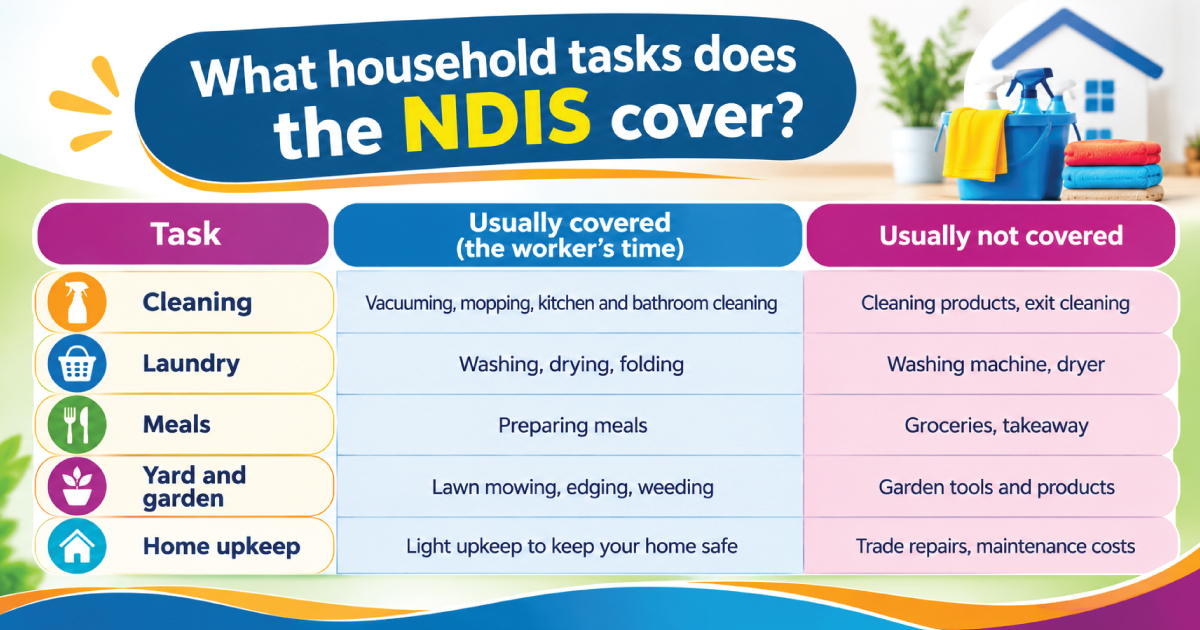
Here’s the rough split. Treat it as a starting point, because your goals and who you live with can tip the answer either way.
| Task | Usually covered (the worker’s time) | Usually not covered |
|---|---|---|
| Cleaning | Vacuuming, mopping, kitchen and bathroom cleaning, dusting, changing bed linen, taking out bins | Cleaning products, exit cleaning when you leave a rental |
| Laundry | Washing, drying, folding, putting away | Washing machine, dryer, detergent |
| Meals | Preparing meals in your home, and the preparation and delivery part of a meal service | Groceries, takeaway, food delivery apps |
| Yard and garden | Lawn mowing, edging, weeding, clearing paths, removing green waste | Garden tools and products, pools, landscaping |
| Home upkeep | Light upkeep your disability stops you doing safely | Trade repairs, renovations, standard maintenance costs |
Can the NDIS pay for cleaning?
It can, and it’s one of the supports people ask us about most. Standing at a sink, kneeling at a bath or pushing a vacuum might be unsafe or impossible for you. A worker can take those jobs on. You’ll still need to keep the cupboard stocked with sprays and cloths, though. Those come out of your own pocket.
Does the NDIS pay for gardening and yard maintenance?
Yards get forgotten in these conversations, which is a shame, because an overgrown path is a fall waiting to happen. Mowing, weeding and clearing a way to the front door can all be funded when your disability gets in the way. The goal is somewhere safe to walk and hang washing. Nobody’s funding a garden makeover, new turf or pool cleaning.
Does the NDIS pay for meal preparation?
A support worker can plan and cook with you, or for you, in your own kitchen. Meal delivery is allowed too, with a catch: the NDIS only pays for the preparation and delivery. You pay for the food, the same as anyone else does at the checkout.
What household tasks are not covered by the NDIS?
The simple test is this. When every household in Australia pays for something, disability or not, the NDIS probably won’t. The NDIA’s own list of supports that are not NDIS supports goes into detail. For jobs around the home, the big ones are:
- groceries, including food, drinks, cleaning, household and health products
- everyday appliances and garden gear, like a fridge, dishwasher, washing machine or garden tools
- standard repairs, renovations, home improvements and maintenance costs
- pools, pool heating and pool upkeep
- rental costs such as exit cleaning, pest control and fixing general damage
- takeaway and food delivery apps, unless the meal service lists the food cost separately
Keep this in mind when you plan your budget. The funding pays for the hands doing the job, never the stuff being cleaned, cooked or fixed.
How does the NDIA decide if you get household help?
Anything in your plan has to be “reasonable and necessary”. With household tasks, that usually comes down to three questions a planner will ask, even if they don’t say them out loud.
- Does your disability stop you doing it? Being tired of vacuuming won’t get you far. Evidence that you can’t vacuum without pain, falls or days of recovery will.
- Could the people you live with reasonably pitch in? The NDIA weighs up what it’s reasonable to expect family and informal supports to provide. Someone living alone is in a very different spot from someone whose family already runs the house.
- Is this the best-value way to meet the need? Sometimes a gadget, or a few months learning a new routine, solves the problem for longer.
That last one surprises people. Paid help isn’t the only option a planner will weigh up, so it’s worth knowing the alternatives before you walk in.
Should you get help, learn the task or use equipment?
In our experience, most plans end up with some combination of these:
- Someone does it, or helps you do it. This is the household tasks support we’ve been talking about, paid from Core.
- You learn to do more of it yourself. Cooking, cleaning and laundry routines can be taught step by step as a capacity-building goal. Our guide to life skills for adults with disability walks through how that funding works.
- The right equipment takes some of the strain. Lightweight vacuums, long-handled dustpans and kitchen aids can shrink the hours you need. We cover the options in how assistive products can support independence at home.
How much can providers charge for household tasks?
Providers can’t charge whatever they like. The NDIA sets an hourly maximum for each support item, and on 19 October 2026 it announced higher price limits from 1 December 2026, following a Fair Work Commission decision to lift wages under Schedule E of the SCHADS Award.
| NDIS support item | Item number | National limit to 30 Nov 2026 | National limit from 1 Dec 2026 |
|---|---|---|---|
| House cleaning and other household activities | 01_020_0120_1_1 | $60.10/hr | $64.59/hr |
| House or yard maintenance | 01_019_0120_1_1 | $59.01/hr | $63.42/hr |
| Assistance with personal domestic activities | 01_004_0107_1_1 | $61.16/hr | $65.73/hr |
Source: NDIA, 19 October 2026. A fourth item, specialised home-based assistance for a child, rises by the same amount as personal domestic activities.
A few things worth knowing. These are ceilings, so plenty of providers sit below them. The item numbers and the claiming process aren’t changing. Providers must talk you through any change to your service agreement, and you must agree before it takes effect, so expect a call or an updated agreement in late November. Remote and very remote areas have higher limits again.
How do you ask for household tasks in your NDIS plan?

Your plan won’t spell out “mow the lawn every second Friday”. Evidence gets this support funded, and the more ordinary and specific it is, the better. Before your next plan reassessment or check-in, try this:
- Write it down for a fortnight. Note which jobs, how long they took, who helped, and what happened on the days nobody did them.
- Get a professional to back you up. An occupational therapist’s functional assessment carries a lot of weight. A letter from your GP or treating therapist helps too.
- Be upfront about your household. Say who lives with you, what they already do, and what they can’t do because of work, health or age.
- Connect it to something you want. Staying in your own place, avoiding another fall, or having enough energy left for work are all fair goals.
- Don’t do it alone. Your Local Area Coordinator, support coordinator or provider can help put the request together.
Planners don’t read provider ads. They read your evidence.
NDIS household safety: what should you check at home?
We’d argue household tasks are really about safety, and tidiness comes second. Walk through your place with fresh eyes and look for:
- Floors: a wet bathroom, a rug that curls at the edge, shoes and boxes in the hallway
- Kitchen: food past its date, a fridge that needs a wipe-out, things stored where you have to stretch
- Chemicals: bleach next to the bread, unlabelled spray bottles
- Outside: long grass over the path, uneven pavers, a green bin too heavy to wheel out
- Laundry: full baskets you carry up steps, a line you can only reach on tiptoe
Show your support worker what you found. That way their time goes on the jobs that keep you upright, rather than a quick polish of the benchtops.
Frequently asked questions
Can the NDIS pay for cleaning?
Yes, when your disability means you can’t clean safely or on your own. The NDIS can fund a worker or cleaner to do floors, bathrooms, kitchens and bed linen. It covers their time only. Cleaning products are a normal household cost, and the support still has to be reasonable and necessary for you.
Does the NDIS pay for lawn mowing and gardening?
It can. House or yard maintenance appears on the NDIA’s list of household tasks, so mowing, weeding and clearing paths may be funded when your disability gets in the way. Tools, landscaping and pool care aren’t included. From 1 December 2026 the national price limit is $63.42 an hour.
Does the NDIS pay for groceries or meals?
Not groceries. The NDIS will pay for help cooking at home, and for the preparation and delivery part of a meal service. The food itself counts as an everyday living cost. Takeaway and food delivery apps are excluded unless the service charges the food separately.
Can I get household help if I live with family?
Sometimes. Planners look at what your family or housemates could reasonably do. Funding is less likely when they already handle the chores. When they work long hours, have their own health issues, or your needs go well past normal sharing, say so and back it up with evidence.
Can I use a cleaner who isn’t NDIS registered?
Usually, when you self-manage or use a plan manager. Plan-managed participants still have to stay within the NDIS price limits. When the NDIA manages your funding directly, you’ll need a registered provider.
Will household tasks be added to my plan automatically?
No. You have to ask, and you have to show how your disability affects these jobs. A diary, a therapist’s report and an honest picture of your household give the planner what they need to say yes.
Need help with household tasks?
A few hours of help each week can be the difference between coping and constantly catching up. To talk through what to ask for, or what’s realistic in your plan, call Urcare and Support Services on 0449 630 680 or contact our team.